
Meriden Estimated Release Date
Connecticut DOC uses “Estimated Release Date” for the main projected field in public offender information. The DOC FAQ also lists Minimum Release Date and Maximum Release Date. Those fields belong to the state correctional record because Connecticut operates both its pretrial jails and sentenced prisons through DOC. A Meriden defendant may therefore be held at New Haven Correctional Center or another state facility, even though the arrest and court case began in Meriden.
The three dates do different work. A minimum date marks a lower sentence or eligibility boundary when applicable. A maximum date reflects the sentence’s outer end as calculated in the record. The estimated date is the best public proxy for when release may occur under current facts. It can account for more than the sentence length. Admission and sentencing dates, jail credit, earned credit, detainers, court changes, discipline, parole, and community-release rules can affect what appears.
The CT DOC offender information search is the official public starting point.
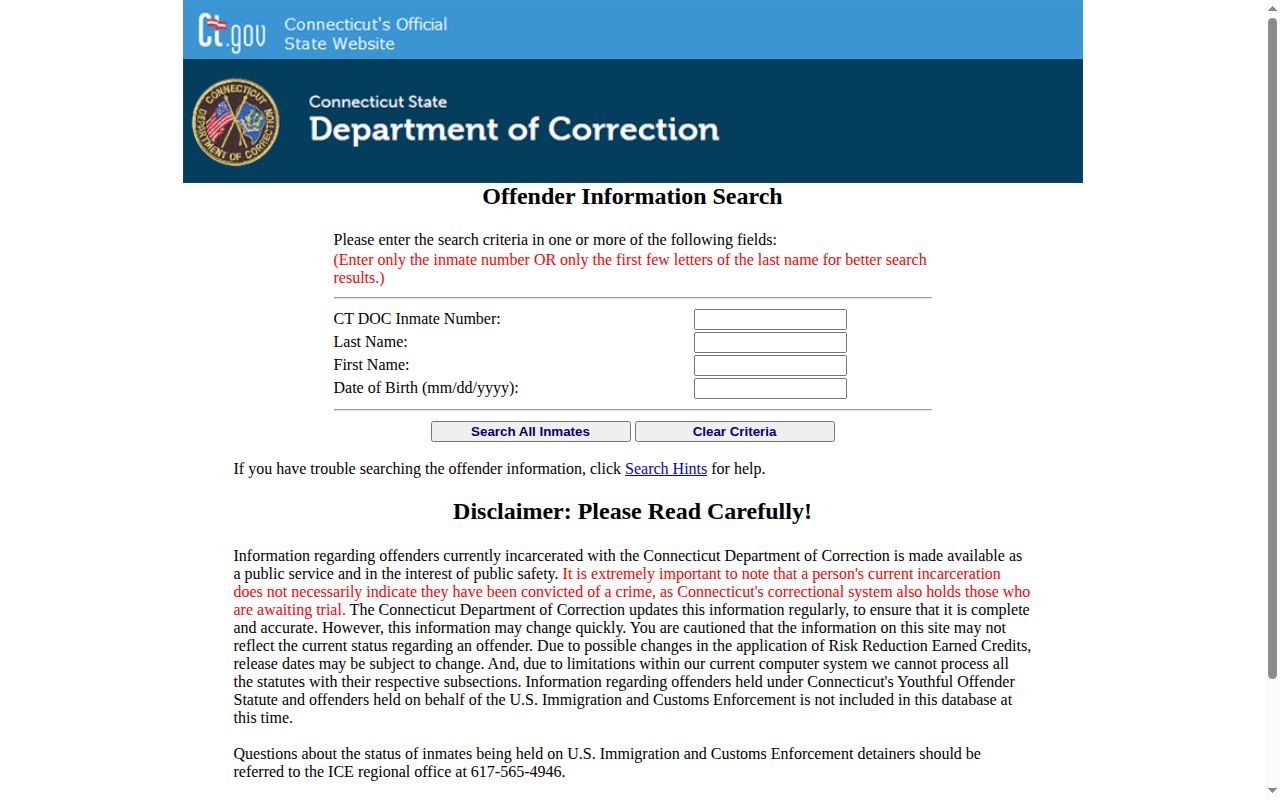
Its detail record should be read with the Meriden court case, not as a stand-alone guarantee.
Find Meriden Projected Release
Begin by deciding whether the person is merely accused or has been sentenced. CT DOC holds both groups. An “accused” or unsentenced status at New Haven Correctional Center means a projected sentence date may not exist. Release may instead turn on bond, a court order, dismissal, transfer, or later sentencing. A sentenced status makes the sentence and release fields more relevant, but current location and detainers still matter.
- Search CT DOC by DOC number when known. Otherwise use the exact last and first name, then check birth information to separate similar names.
- Open the individual detail record. Record status, current location, admission and sentencing dates, sentence terms, minimum, maximum, and estimated release dates, detainer, and special parole end date when shown.
- Open the Judicial Branch conviction search or pending-case search. Match the docket, court, disposition, and sentence to the DOC record.
- Check BOPP material if parole applies. Separate the hearing date, eligibility date, Board vote, voted-to-parole date, and actual release.
- Recheck close to the listed date. Use CT SAVIN or DOC Public Information to confirm the actual custody change.
A person released directly after Meriden police processing follows a different path. A short police hold is not calculated through DOC good time. Bond, a summons, court action, or transfer determines the result. Use Meriden Police Records and the court docket. If the person entered New Haven Correctional Center, return to the statewide DOC framework.
Note: Save the access date because CT DOC updates daily and warns that current status and release dates may change quickly.
Meriden Release Date Fields
A projected date makes sense only beside the rest of the detail record. Status distinguishes an accused person from a sentenced one. Current location can show that the person moved between state facilities instead of leaving custody. A detainer means another authority has lodged a hold, which may prevent release to the community even when a sentence date arrives. Special parole end date concerns a later supervision endpoint and should not be read as the facility exit date.
| Field | How to read it |
|---|---|
| Status | Shows whether the person is accused, sentenced, or in another displayed state |
| Current location | Distinguishes a facility placement from release or community status |
| Minimum release date | A lower sentence or release boundary when applicable |
| Maximum release date | The calculated outer sentence date shown by DOC |
| Estimated release date | The current projected date, subject to change |
| Detainer | A hold that may affect whether release is to the community |
| Special parole end date | A supervision end point that can follow physical release |
CT DOC’s official FAQ field inventory also includes name, inmate number, date of birth, controlling offense, admission date, sentence terms, photograph, correctional history, and disciplinary history. Those facts help verify identity and explain why a displayed date is present.
Calculate Meriden Projected Release
No single public formula can reproduce the CT DOC Estimated Release Date. DOC begins with the controlling sentence, admission and sentencing dates, and applicable jail credit. It then applies the statutes and agency decisions that fit the individual case. Risk reduction credit may affect an eligible sentence. A short-sentence community program may change when a person leaves a facility. Parole can create an earlier supervised release path, while a detainer or new court order can prevent release to the community.
The date should be read as a current administrative result. It is not just the maximum sentence minus a standard number of days. Connecticut’s rules depend on offense, sentence, eligibility, credit, discipline, court action, and supervision status. Record the minimum, maximum, and estimated dates together. Then check for a detainer, special parole end date, or Board action. That full set explains far more than one projected field viewed alone.
Meriden Earned Release Credit
Connecticut General Statutes § 18-98e governs Risk Reduction Earned Credit. Eligible CT DOC inmates may earn credit under the statute, and DOC review determines whether it applies. Credit should not be described as automatic or as one fixed reduction for every person. The statute requires review before a release that is based on the sentence reduction, and eligibility can turn on the person’s circumstances and DOC rules.
The sentence starts with the court judgment and applicable jail credit. Earned credit may then affect the calculated date. Discipline, eligibility review, or changes in awarded credit can change the display. Connecticut also has separate parole law, short-sentence community-release provisions, and supervision rules. Those systems interact with the practical day a person leaves a facility, but none converts the estimated date into a promise.
A short local police hold has no earned-time calculation. Once a court commits a person to New Haven Correctional Center or another DOC site, the state sentence and credit framework applies.
Meriden Short-Sentence Release Rules
Chapter 325 of the Connecticut statutes includes a distinct route for certain definite sentences of two years or less. Section 18-100c allows release to specified community-correction or commissioner-approved programs after not less than one-half of the sentence, less applicable statutory credits, for people within the provision. That does not mean every short sentence ends at one-half. It describes eligibility for a program route under state control.
Section 18-100d provides continued DOC supervision until expiration of the maximum term, less applicable risk reduction credit, for qualifying crimes committed on or after October 1, 1994. The key point is simple: leaving the prison building and finishing the sentence can be different dates. A community placement may change location without ending state supervision. Compare the estimated date, location, status, and supervision fields before calling the person fully discharged.
For Meriden cases, these are statewide rules. New Haven Correctional Center serves the Meriden court, and a sentenced person can later move within DOC. The public search stays statewide even when the court file remains tied to Meriden Geographical Area 7.
Meriden Parole Release Timing
Parole eligibility and projected release are related but not identical. Connecticut General Statutes § 54-125a governs major parts of eligibility. The Board of Pardons and Paroles decides suitability in eligible cases. BOPP says hearings are commonly scheduled about six months before eligibility, yet the Board may deny parole, set a later hearing, continue a matter, or vote to parole. None of those hearing stages changes custody by itself.
BOPP describes a voted-to-parole date as “on or after.” It is the first possible date under that vote. Release can wait for conditions, placement, sponsor details, transportation, or other coordination. As the date nears, Parole & Community Services staff contact the person and sponsor about pickup or transport. Check CT DOC and CT SAVIN after the date for evidence that the custody event occurred.
Connecticut’s “85%” language also needs care. BOPP identifies an offense category called 85% parole-eligible offenses, but that is not a rule that every person serves the same share. Eligibility depends on the offense and statute. Special youth-sentencing eligibility under Public Acts 15-84 and 23-169 follows separate thresholds described by BOPP, so it should not be used as a general formula.
The BOPP parole FAQ shows the practical steps between eligibility and release.
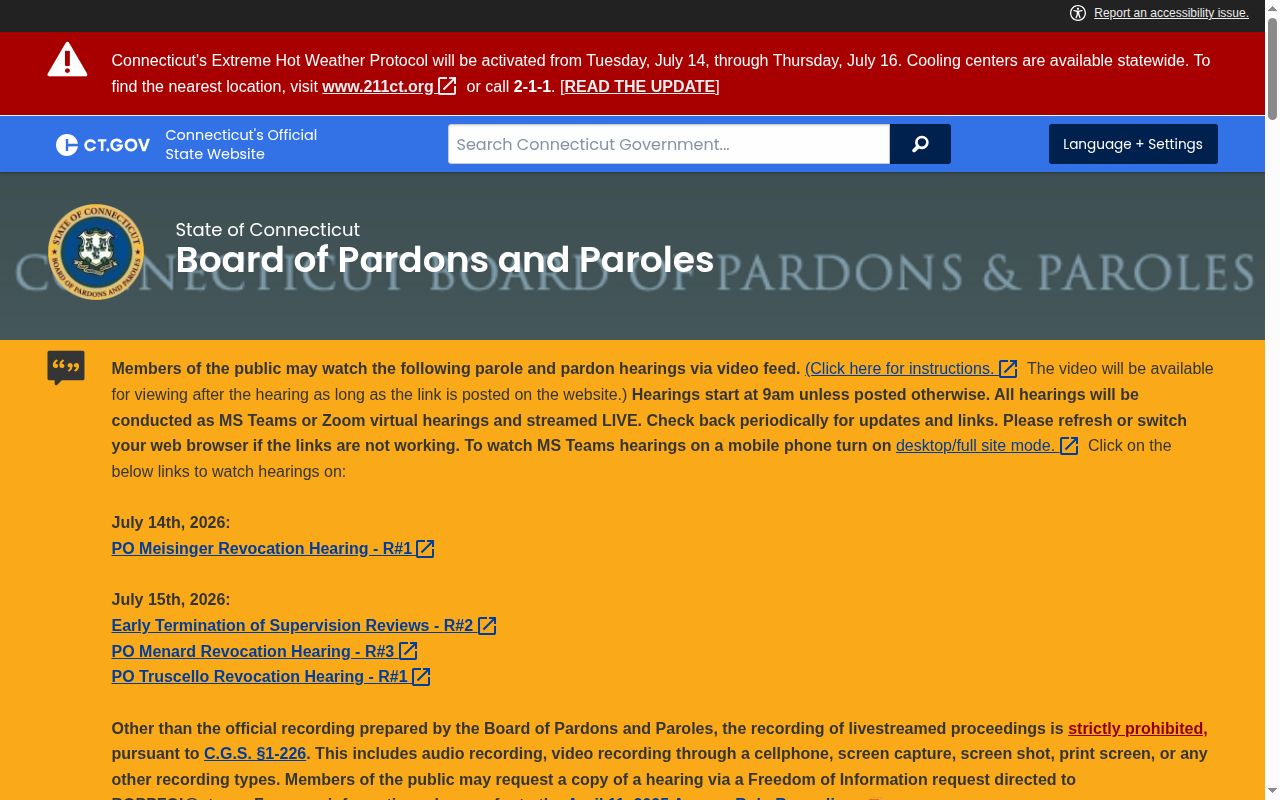
Its “on or after” wording is the clearest reason to confirm release after the projected date rather than treating the vote as final proof.
Why Meriden Release Dates Change
The public date reflects the facts available to DOC at that point. Some changes affect sentence computation. Others affect whether a person can actually leave for the community. A date can move earlier or later, while a detainer can leave the date in place but change where the person goes next. Always examine the updated status and location along with the date.
| Factor | Possible effect |
|---|---|
| Risk reduction credit | Eligible awarded credit may reduce the calculated term after review |
| Disciplinary or eligibility change | Credit may be denied, changed, restored, or reviewed |
| Court order or appeal | The sentence or custody basis may be modified |
| Detainer or new charge | Release to the street may be blocked or custody may shift |
| Parole decision | Release may be denied, delayed, or approved on or after a date |
| Community placement | The person may leave a facility while supervision continues |
| Data update | The public field may lag a recent agency action |
A transfer within DOC is not release. An ICE detainer or another authority’s hold can also mean the person does not enter the community. Youthful-offender restrictions may limit the public result. If no record appears, use the court, DOC Public Information, or the correct federal system instead of assuming the projected date passed as expected.
Note: Recheck the complete record near the date and confirm the actual event through CT SAVIN or DOC Public Information.
Confirm Meriden Actual Release
Confirmation starts after the forecasted date. Reopen CT DOC and compare status, location, and date fields. Check the court docket for a sentence change, bond event, dismissal, or new order. If registered in advance, CT SAVIN may send a bond-out, court-discharge, community-release, end-of-sentence, or other custody notice. The exact label tells more than the word “released.”
For a named person whose current DOC result has disappeared, the full Meriden released-inmate search includes the court and records-request paths. The Meriden VINELink inmate search explains how to register correctional and court alerts under both CT SAVIN tabs. Those two internal routes serve different needs: one reconstructs a release after the fact, while the other watches an active case for change.
If the public record remains unclear, contact CT DOC Public Information at (860) 692-7780 from 8:00 a.m. to 4:30 p.m. Monday through Friday, or write to 24 Wolcott Hill Road, Wethersfield, CT 06109. Provide the full name, DOC number, facility, approximate dates, and the specific release or discharge fact sought. A precise request is more likely to separate facility release, community placement, parole, and final discharge.