
Meriden Parole Versus Probation
Parole and probation are both forms of community supervision, but they start in different ways. Parole is a conditional release from a prison term. The Connecticut Board of Pardons and Paroles decides whether an eligible person may leave a correctional facility under parole conditions. CT DOC Parole & Community Services then handles field supervision. Special parole is also a court-imposed period of supervision that follows incarceration and may appear in a CT DOC record.
Probation begins with the court judgment. A Meriden court can impose probation as part of a sentence without a parole decision. The Connecticut Judicial Branch Court Support Services Division supervises adult probation. The court docket is therefore the best first record for deciding whether probation was ordered. Neither label should be inferred just because someone is no longer at New Haven Correctional Center. A person may have posted bond, finished a sentence, moved to another facility, or been discharged with no active supervision.
| Point | Parole | Probation |
|---|---|---|
| How it starts | BOPP grants conditional release from incarceration | A court includes it in the sentence |
| Main authority | BOPP and CT DOC Parole & Community Services | Judicial Branch Adult Probation |
| Best first record | CT DOC detail and BOPP hearing material | Judicial Branch disposition and sentence |
| End point | Parole or special-parole discharge date | Completion or court-ordered discharge |
- Parole
- Conditional release from incarceration before the sentence framework is fully complete.
- Probation
- Court-ordered supervision in the community, sometimes imposed instead of or after confinement.
- Discharge
- The formal end of custody or supervision under the applicable sentence.
- Absconder
- A supervised person alleged to have stopped reporting or left supervision without permission.
Verify Meriden Post-Release Supervision
Start with identity and custody type. Connecticut runs both pretrial jails and sentenced prisons through CT DOC, so the statewide search can contain an accused person at New Haven Correctional Center and a sentenced person at Cheshire Correctional Institution. A released Meriden police detainee who never entered DOC may have no CT DOC record. Use the DOC number when known, and match the result to a Meriden court docket before deciding that a supervision status belongs to the right person.
- Search the CT DOC offender information system by DOC number or exact name. Review status, location, release fields, detainer information, and any special parole end date.
- Open the Judicial Branch conviction search or pending-case search. Match the name, docket, court, disposition, and sentence, including any probation term.
- Check BOPP hearing information when parole applies. A hearing entry or vote provides parole context, but it does not prove that physical release has occurred.
- Use CT SAVIN for covered custody, parole-hearing, community-release, end-of-sentence, escape, or return-to-custody notifications. Register under the correctional and court tabs when both tracks matter.
- Contact the responsible office only after the record type is clear. Adult Probation handles court probation, while BOPP and DOC handle parole and special parole.
The full Meriden County released-inmate search covers police, DOC, court, federal, and immigration custody paths when the first result does not resolve the status. Save the date accessed because CT DOC warns that its information can change quickly. A missing current record may reflect full discharge, restricted youthful-offender information, a different custody system, or lawful erasure rather than proof of any one outcome.
Meriden Parole Hearing Records
BOPP posts hearing access and a dated hearings and events calendar. The Board says hearings generally start at 9 a.m. unless a posting says otherwise and may be conducted by video. Its parole FAQ explains that eligible people are commonly heard about six months before eligibility, although reviews may be continued for more facts, evaluations, or a transfer. A listing is a scheduled event, not a release list.
The Board can deny parole, set a later hearing, reconsider in limited circumstances, or vote to parole. Even a favorable vote does not establish the exact day a person walks out. BOPP calls the voted-to-parole date an “on or after” date because release planning, conditions, placement, and transport must align. The CT DOC record and CT SAVIN custody update are better evidence of the later physical release.
The official BOPP parole FAQ shows how eligibility, hearing, vote, and release are separate stages.
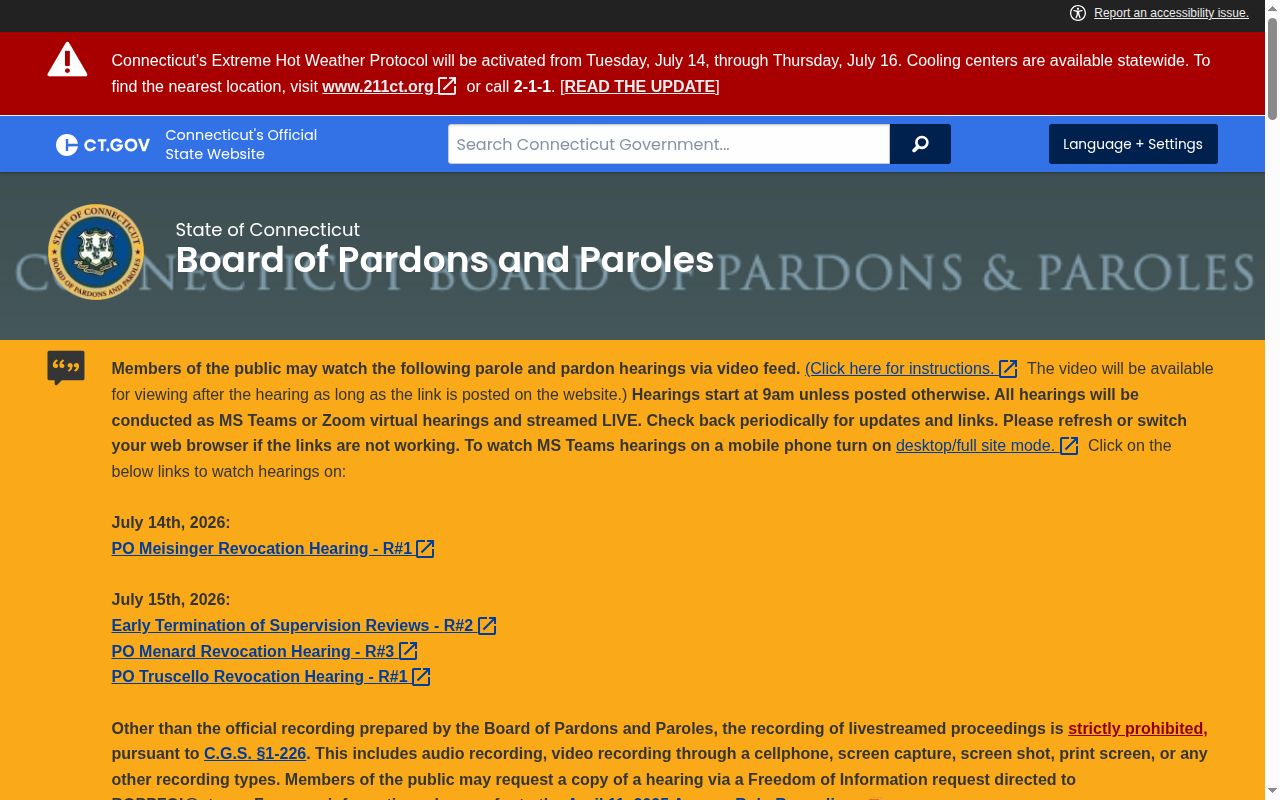
That distinction prevents a posted hearing or Board vote from being mistaken for a completed Meriden release.
Note: BOPP prohibits recording its livestreams, while an official hearing recording may be requested through its Freedom of Information process.
Meriden Reentry Supervision Landscape
Meriden’s post-release system is split by legal authority, not by one local reentry office. A person released from prison to parole remains on the DOC and BOPP track. A person sentenced to probation stays on the Judicial Branch track. CT DOC Victim Services adds a statewide notification layer for community-release reviews, placements, parole hearings, end-of-sentence events, and returns to custody. The local court docket connects those state systems to the Meriden case.
This division matters when arranging support or checking an appointment. The office named in the supervision record controls. Meriden Adult Probation serves several nearby towns as well as the city, while parole field services operate through the state correctional structure. Ask first whether the court ordered probation, BOPP granted parole, special parole follows the prison term, or no supervision remains. That answer prevents a person from being routed to an office that does not own the case.
Meriden Supervision Office Routes
Meriden has a local Adult Probation office, but no combined parole-and-probation counter. The office is identified in the 211 Connecticut listing as serving Meriden, Cheshire, Hamden, North Haven, and Wallingford. It is an office for court supervision, not a public roster of released people. Bring the docket number and court disposition when seeking allowed procedural information. Those facts help staff distinguish a probation sentence from parole or a current criminal case.
Meriden Adult Probation
165 Miller Street
Meriden, CT 06451
Phone: 203-238-6315
Parole questions route to the Connecticut Board of Pardons and Paroles and CT DOC Parole & Community Services. Offender-information questions beyond the public search route to CT DOC Public Information at (860) 692-7780, Monday through Friday from 8:00 a.m. to 4:30 p.m., or 24 Wolcott Hill Road, Wethersfield, CT 06109. The agency that owns the record is the one that can explain or correct it.
Meriden Supervision Violations
Conditions vary by the sentence and Board order. Common requirements can include reporting, approved residence, treatment, travel limits, and compliance with court or parole instructions, but the controlling terms are the ones in that person’s record. A suspected violation does not automatically mean a new conviction. It can produce an investigation, a court filing, a warrant, a return to custody, or a revocation hearing, depending on whether the person is on probation, parole, or special parole.
BOPP’s Revocation Unit schedules and conducts parole rescission and parole or special-parole revocation matters. Rescission concerns a parole grant before release, while revocation concerns supervision after release. Probation violations follow the Judicial Branch court track. No official Meriden-wide absconder list was found, so use the court docket, CT SAVIN notifications, CT DOC status, and the responsible agency. Do not treat an old status as current.
CT SAVIN includes escape or absconding, return-to-custody, and community-release events among its covered notification types. It can help with a specific active record, but it is not a permanent archive. Notifications can end after full sentence discharge unless the person returns to the system and the registrant signs up again.
Note: Confirm a warrant or violation through the court or supervising agency because notification and public-search updates can lag.
Meriden Release Documents After Supervision
Property and record issues should go back to the releasing or supervising agency. For papers or property linked to a short Meriden police hold, contact the Meriden Police Records Division. For a DOC release, movement history, or supervision field, begin with DOC Public Information. A court disposition is needed when the issue concerns the sentence, probation, dismissal, or another judicial outcome.
Bring the police case number, DOC number, court docket, and relevant dates when possible. These identifiers reduce mistaken matches. If a field appears wrong, ask the agency that maintains that field for its correction process. DESPP’s State Police Bureau of Identification handles a separate state criminal-history and fingerprint record category. It does not replace a release, parole, or probation record.
Meriden Supervision Discharge
Supervision ends through the authority that imposed it. Parole or special-parole discharge belongs to the DOC and BOPP track. Probation completion belongs to the court and Adult Probation track. A facility release date and a supervision end date are often different. For some Connecticut sentences, a person can leave a facility for a community placement or parole while remaining subject to state control until the applicable sentence term or supervision period ends.
After full discharge, current DOC or SAVIN coverage may stop. The Judicial Branch disposition can remain the more durable public record, subject to erasure, youthful-offender rules, and other lawful limits. Connecticut General Statutes § 54-125a governs major parts of parole eligibility, while the actual discharge facts must be verified in the individual agency record. A past BOPP calendar or facility departure should never be used as a substitute for that final status.
A clean verification uses three dates: the physical facility release, the start or continuation of supervision, and the formal discharge. When those dates do not align, the court judgment, CT DOC detail, and supervising agency explain which legal status remained active.